Cyborg Sessions
Workshop, Exhibition, and Keynote
Shelby Doyle, Leslie Forehand, and Nick Senske
Keynote: Madeline Gannon
See also:
www.design.iastate.edu/news/2017/10/cyborg-sessions/
Workshop, Exhibition, and Keynote
Shelby Doyle, Leslie Forehand, and Nick Senske
Keynote: Madeline Gannon
See also:
www.design.iastate.edu/news/2017/10/cyborg-sessions/
Women in Robotics Workshop + Exhibition
Women in the United States are historically underrepresented in many design professions. This gender imbalance may at last be successfully challenged in the twenty-first century through the mechanism of technological agency. Today, design has been transformed by new technologies, such as CNC machining, 3D printing, and robotics, that offer disruptive potentials in material practice. These technologies present opportunities for subverting current power structures and are potent tools of feminist practice.
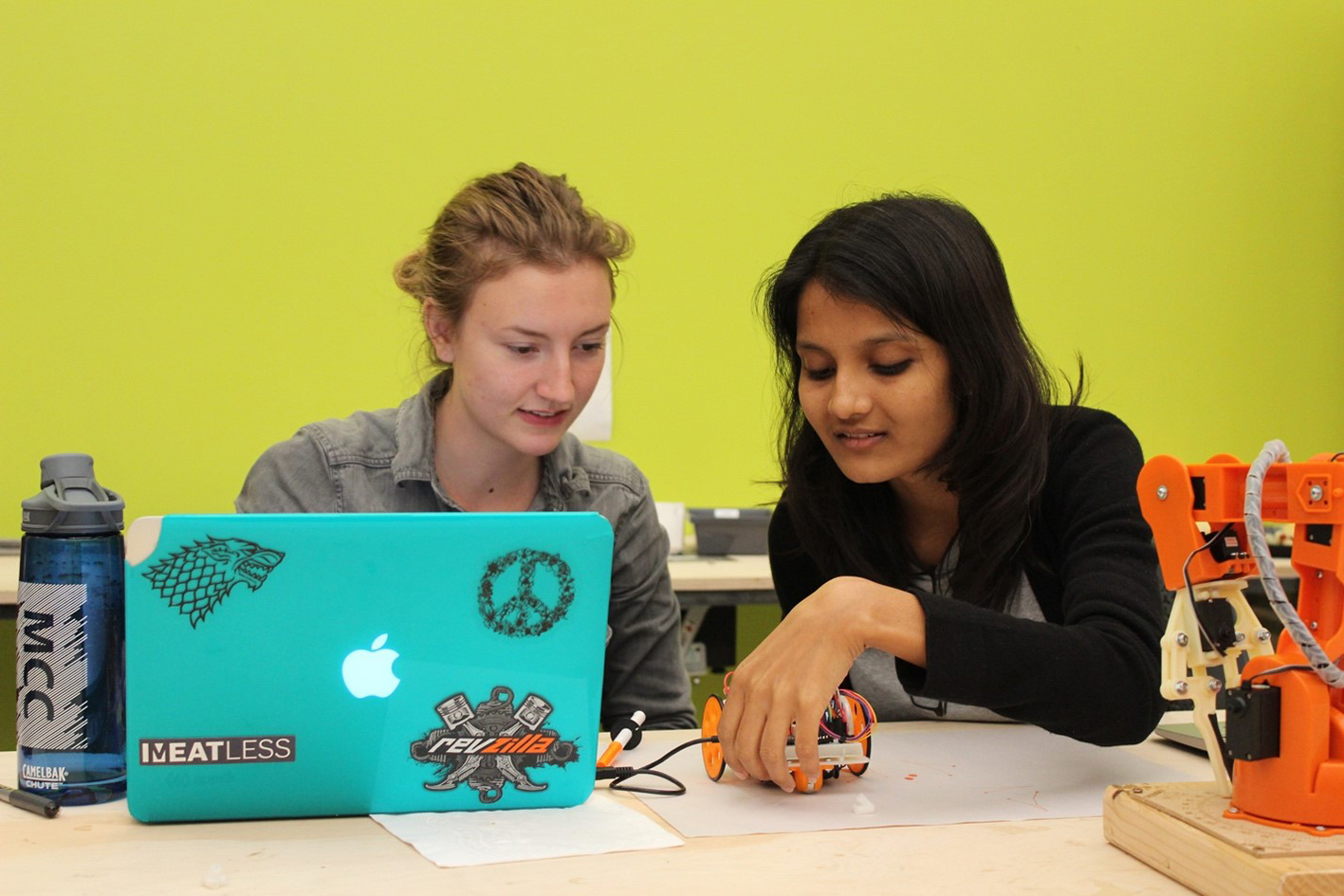
The goals of this workshop are to democratize access to computational tools and knowledge for women and to explore the potential of feminist making with advanced technologies. For six weeks, twenty-one students met once a week to learn how to program robots to make drawings and paintings. The work in this exhibition reflects their efforts to enlist an unfamiliar partner (the robot) to revisit familiar media and produce artifacts that are indeterminate, sensual, and joyful, as a counterpoint to traditionally masculine computational production.
PART 1 – PLAYING TURTLE
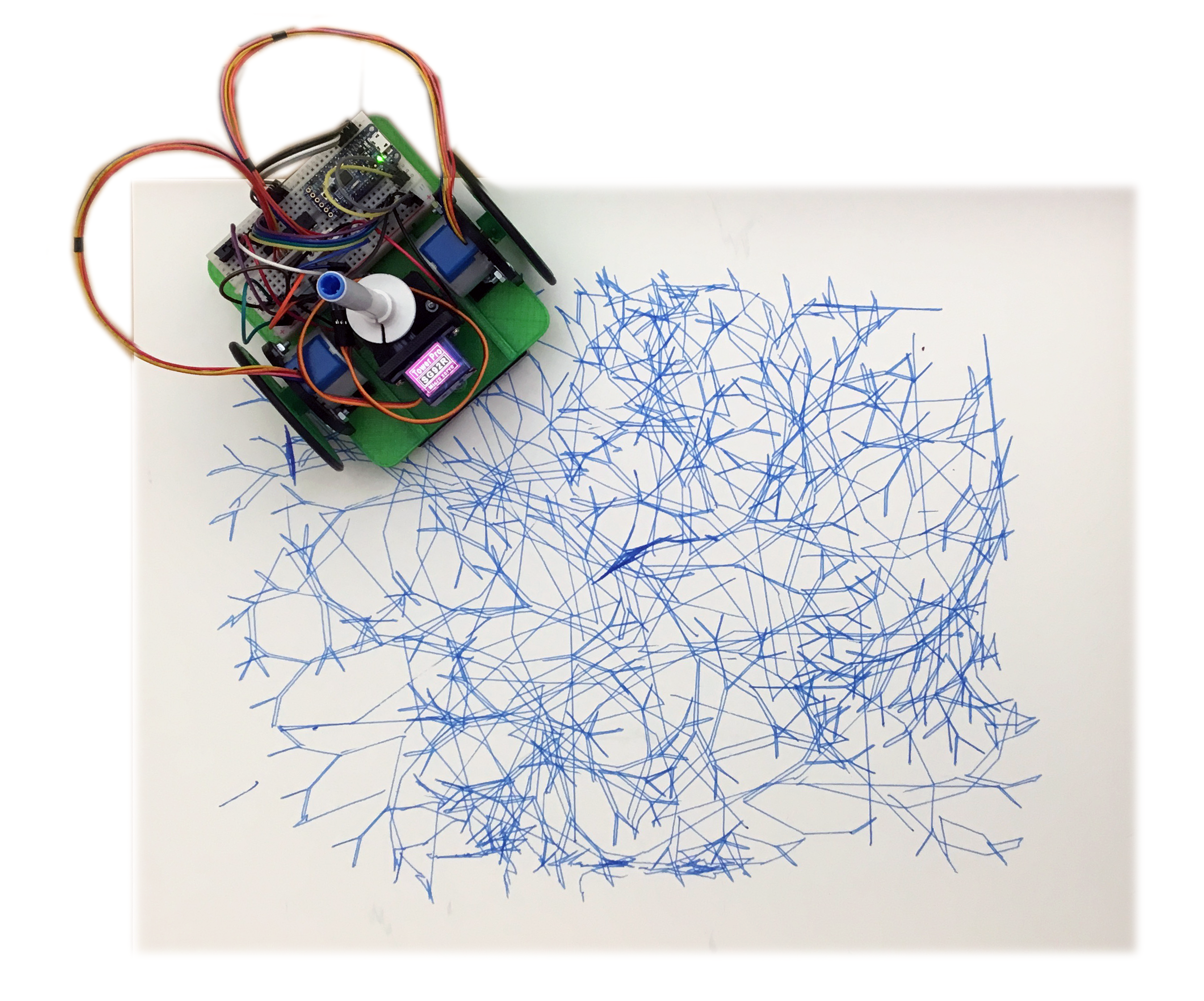
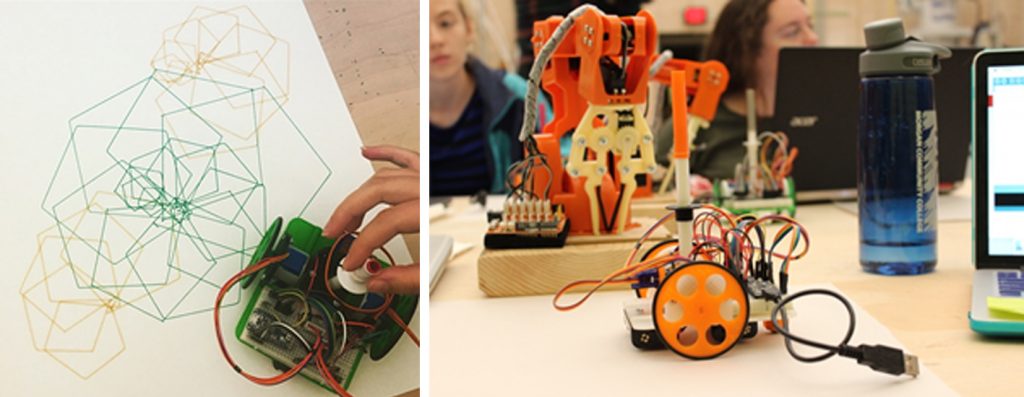
Turtles are a classic pedagogical tool, created by Seymour Papert at MIT, to teach children how to think computationally by programming a small robot to construct drawings. Turtles have a “head” and “tail” and use simple instructions to move around a surface while leaving a marker trail. Students learn to program a Turtle by pretending to “be” the Turtle, connecting their sense of their own body in space with that of the robot’s. Thus, “playing turtle” is a profound way to bridge human and machine in the fundamental design act of drawing.
In this early project, students learned the basic syntax and logics of computer programming while becoming comfortable with the rhythms of making through cycles of writing, compiling, and testing their code.
PART 2 – DANCES WITH ROBOTS
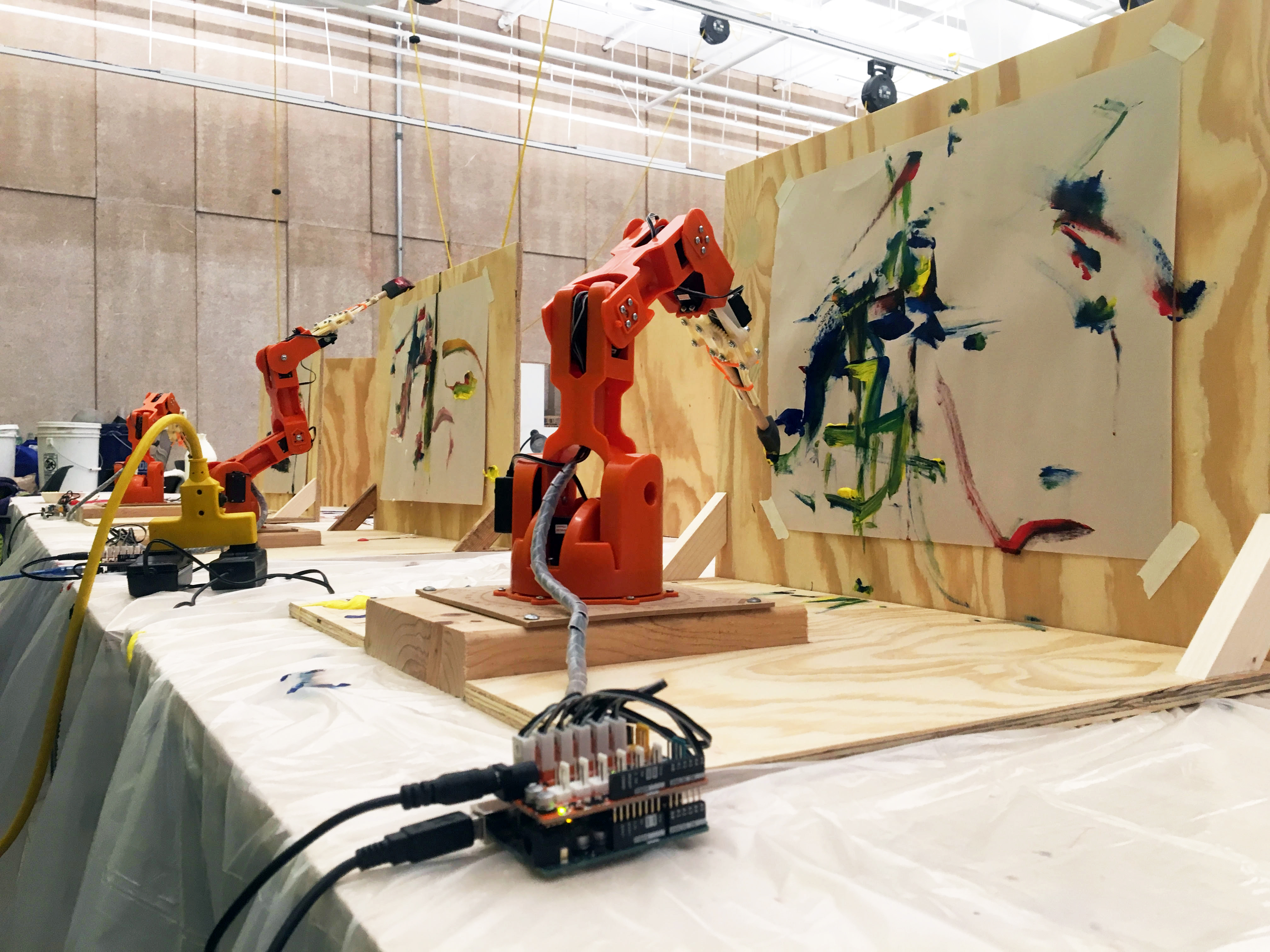
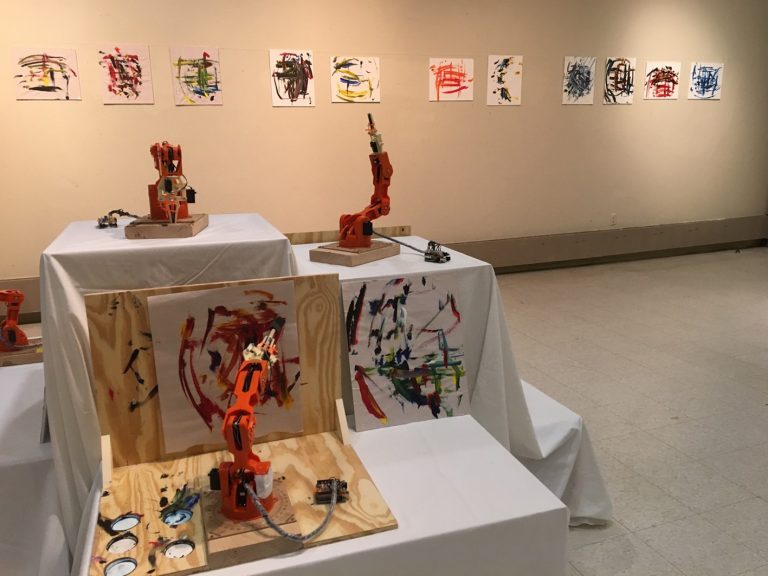
The objectives of the second project are to further develop confidence with robotics and to move away from the precision of drawing to the indeterminacy and expressiveness of painting. To achieve this, the students worked with robotic arms that have brushes attached to them. Students must learn to work back-and-forth with the robot to develop a series of “strokes” and workflows such as loading the brush with paint. They do this through feedback loops that combine “canned” algorithms with demonstrative programming (teaching the robot by moving it into position). Eventually, they learn to paint with their robots by stepping back, reflecting, and iterating as they create together.
Ultimately, we ask the participants to consider how making with robots in a certain way might represent a perspective or a process that is female. And, more broadly, how does the experience of working with a cognitive tool (the robot as a co-author) lead one to think about the future of design with such tools?
EXHIBITION
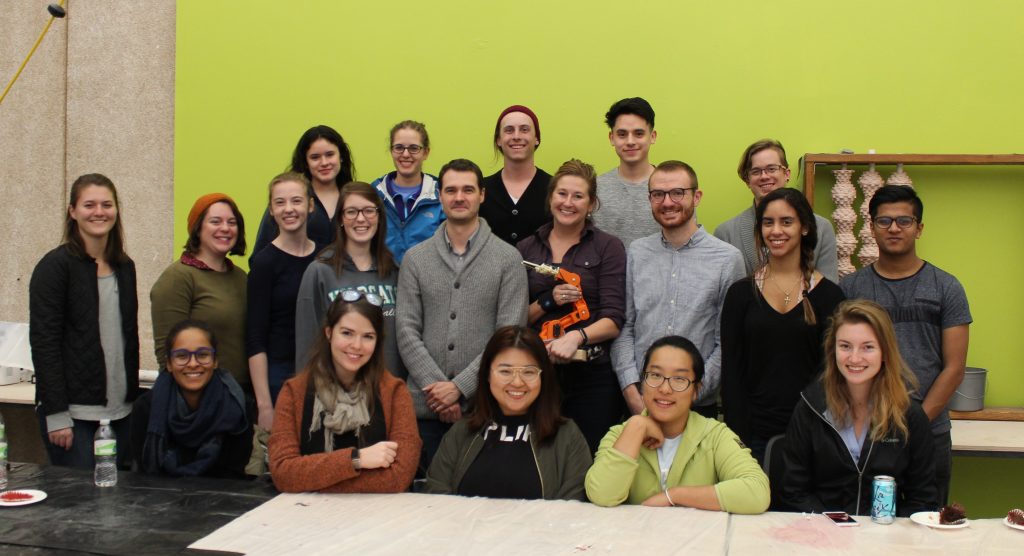
The workshop culminated with a public exhibition, guest critique, and lecture by roboticist, Madeline Gannon. Gannon is a self-described “robot whisperer” with a passion for inventing better ways to communicate with machines that make things. She currently leads ATONATON, a research studio scouting the untapped potential of emerging technologies.
The exhibition included the robots used to co-author the paintings and drawings. Additionally, it presented the conceptual framework for the workshop to the public. It was widely attended by College of Design students and faculty helping to demystify design technology and to generate the culture that is necessary for these technologies to thrive.
A CASE STUDY FOR GENDER EQUITY IN TECHNOLOGY
Findings from the workshop were published and presented at CAADRIA 2018 at Tsinghua University, Beijing, China.
INSTRUCTORS
Shelby Doyle, AIA, NCARB, Assistant Professor of Architecture
Leslie Forehand, Lecturer in Architecture
Nick Senske, Assistant Professor of Architecture
Erin Hunt, CCL Lab Associate
Nick Loughrey, CCL Undergrad Research Assistant
Sarah Schneider, CCL Undergrad Research Assistant
STUDENTS
Camelia Betancourt, Arpit Chunawala, Kelly Devitt, Ian Dillon, Aaron Hauptmann, Shan He, Yichen Li, Himali Limbad, Xinman Liu, Kelsey Maier, Katie McCoy, Melissa Miller, Krithika Mohan, Patricia Mutebi, Naomi Njonjo, Alonso Ortega, Karla Ortega, Monica Pearson, Chris Perez, Grace Reynolds, Shambhavi Srivastava
ACKNOWLEDGEMENTS
The workshop and exhibition were made possible by funding from the ISU Women’s and Diversity Grant Program (recently renamed the Inclusion Initiatives Grant Program).
Madeline Gannon’s lecture was co-sponsored by the ISU Department of Architecture, ISU Department of Art & Visual Culture, ISU Department of Graphic Design, ISU Department of Landscape Architecture, and ISU College of Design Lectures & Exhibitions Committee with additional funding from the ISU Inclusion Initiatives Grant Program.